Looking for the Helpers
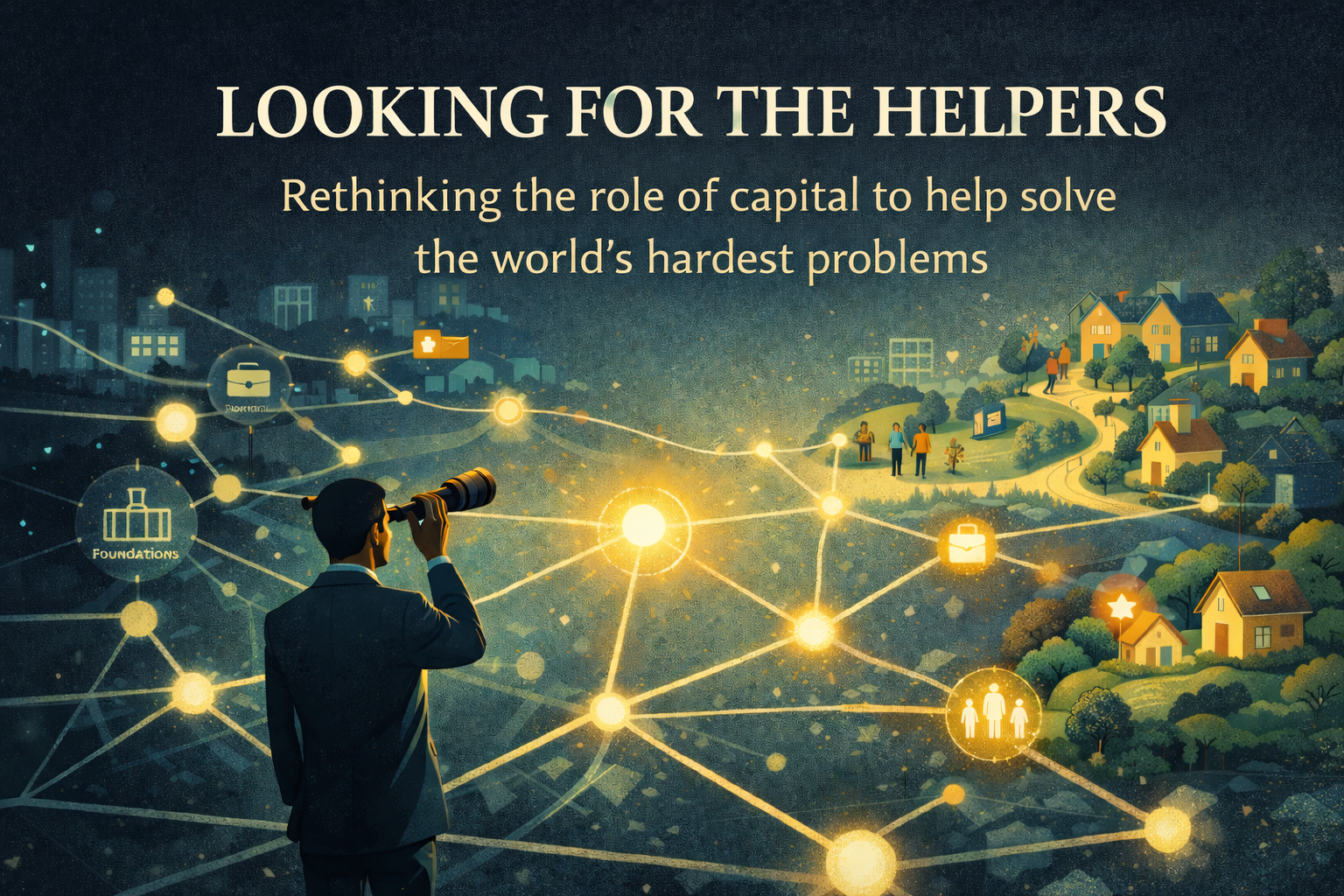
Kasem Rodriguez Mohsen is rethinking the role of capital to help solve the world’s hardest problems
American television personality Fred Rogers told children that when something bad happens, they should always look for the helpers. “There will always be people helping, and if you look for them,” he said, “you will know that there is hope.” Kasem Rodriguez Mohsen believes those helpers are still out there, ready to provide support.
In a world that can often feel chaotic, fractured, and filled with injustice, Mohsen remains convinced that people are working (sometimes quietly, sometimes inside powerful institutions) to build something better. “We’re out there,” he says. “Things are bad, but trust me, there’s mutual aid happening.”
That optimism sits at the heart of Mohsen’s work today. A capital systems architect and philanthropic advisor, he operates at the intersection of philanthropy, venture capital, and public funding. His focus is deceptively simple: helping institutions rethink how capital flows so it can better support communities and the entrepreneurs working to solve complex social problems. He’ll offer support through his TEDxMtHood talk on May 16 in Monmouth, Oregon where he’ll discuss how metaphors shape systems — when shorthand hardens into rules, people end up governed by assumptions they can’t see. “Institutions have agency,” he said, “but they don’t have to follow the rules they inherit.”
Mohsen didn’t arrive at this work through theory. He arrived at this through experience, first by learning how high-performing teams function and later by experiencing firsthand the incentives that shape the venture capital world.
Learning to See Systems
Mohsen’s career began as a data scientist embedded within some of the world’s most elite defense teams. Out of college, he worked alongside organizational psychologists studying high-performing military units, think Navy SEALs, submarine crews, and other specialized teams operating in environments where success depends on extraordinary levels of trust, coordination, and decision-making under pressure. “These are teams operating in extremely compressed timelines where it’s critical to perform at a high level together,” Mohsen explains.
His role was to translate behavioral insights into data narratives that military leaders could understand and act upon. By quantifying the impact of psychological training and team development practices, Mohsen and his colleagues demonstrated the return on investment of building stronger teams. The work gave him something he still relies on today: a deep sense of systems literacy and pattern recognition. “My role was to see our system inside broader systems,” he says.
Over six years of working with these teams around the world, Mohsen developed a practical understanding of how incentives, mission alignment, and organizational design shape outcomes. When systems are aligned, he observed, teams can produce results far greater than the sum of their individual contributions. Those lessons would later shape how he approached entrepreneurship. “It's that gestalt effect,” he explains – where the whole becomes greater than its parts.
Success and a Growing Unease
Mohsen eventually left the defense world to build a medical technology company focused on reducing HIV/AIDS, tuberculosis, and related health burdens in Africa. The company grew quickly. It raised venture capital, expanded its operations, and eventually pivoted into the pharmaceutical sector in the United States. By conventional standards, it was a success story that scaled rapidly before ultimately being acquired by WebMD. From the outside, the trajectory looked familiar: a founder launches a promising company, raises capital, and exits successfully. But internally, Mohsen experienced something very different.
Over time, the company’s mission began to shift as investor expectations and financial pressures mounted. Strategic decisions increasingly revolved around profitability and growth rather than the social impact that had originally inspired the venture. “The trajectory had everything to do with the types of capital we accepted, the terms we accepted them on, and the expectations that were set,” Mohsen says. Eventually, the company was forced into a series of major pivots. The changes were driven less by mission than by the realities of venture-backed growth.
“What I learned in capital is that until you get to the top,” he says, “you don’t really understand all the incentives that cascade down.” The experience left him with a stark realization: “What I gave was my mission, and what I got back was money and a story.” But rather than walking away from the system entirely, Mohsen decided to understand it more deeply. “I’ve just been clawing my way to the top ever since,” he says.
Rethinking Capital
Today, Mohsen works with foundations, universities, investment committees, and international organizations to help them rethink how capital can be deployed to generate both financial and social returns. He describes his work simply as philanthropic advising, but the role goes far beyond traditional grantmaking.
Mohsen has lived inside capital systems from multiple vantage points: as an entrepreneur seeking funding, a fund manager allocating resources, an educator training future social entrepreneurs, and now a systems-level advisor helping institutions design new investment models.
What drives him today is a conviction that enormous financial resources already exist to address many of society’s most pressing problems. Still, the systems governing those resources often prevent them from reaching the communities that need them most.
“There’s roughly $3.5 trillion sitting inside corporations and private foundations,” Mohsen says. That capital has the incredible potential to build strength and vitality in communities. Yet institutional structures, risk tolerance, and longstanding norms often keep much of that capital locked inside traditional philanthropic approaches rather than flowing toward new solutions.
“We’re facing a moment where we need to think more aggressively,” he says. “We need shorter, more impactful cycles if we’re going to meet the moment.” Instead of treating grants as the default model for philanthropy, Mohsen works with institutions to explore new approaches (mission-related investments, program-related investments, and hybrid capital models) that allow organizations to pursue impact while remaining financially responsible. For Mohsen, the goal isn’t simply to move money differently. It’s to change how institutions think about risk, opportunity, and responsibility.
Teaching the Next Generation
Alongside his advisory work, Mohsen also teaches two courses in the social entrepreneurship track at Portland State University’s School of Business. In the classroom, he shares both the successes and the lessons from his own career with students preparing to build companies, nonprofits, and new institutional models of their own. Many of those lessons revolve around incentives, the invisible forces that shape decisions inside organizations and financial systems.
Even after multiple successful exits, Mohsen says he began noticing something unsettling about the traditional entrepreneurial path. “At the end of that rainbow,” he says, “there’s always a little bit of discontent.”
The realization pushed him to examine the broader structures that influence those outcomes, illustrating how decisions made higher up the capital stack shape the possibilities available to entrepreneurs and communities further down the stack. That systems-level perspective continues to guide his work today.
Looking for the Helpers
Despite some of the flaws he sees in existing capital systems, Mohsen remains fundamentally optimistic. He believes change is already underway and that many people working inside powerful institutions are actively trying to rethink the rules. “There are folks in influential positions who are brilliant and asking, ‘How do we do things differently?’” he says. “There are helpers.”
For Mohsen, the challenge now is finding and connecting the people willing to experiment with new models of capital and encouraging them to move faster. “So, what I’m doing right now,” he says, “is looking for the helpers. Who wants to run toward this thing and figure out a better way?”
If he’s right, the helpers Fred Rogers spoke about may not only be the people running toward crises. They may also be the ones quietly redesigning the systems meant to prevent them.
About the author: Jon Rahl works in Municipal Government for the City of Seaside, where he currently serves as the Assistant City Manager and Human Resources Director, and previously worked as the City’s Tourism Marketing Director and Public Information Officer. Jon is an exit project away from completing his master’s degree in organizational leadership from Western Oregon University in spring 2026. He resides in Gearhart, Oregon, loves golfing, hiking with his family, the power of connection, adventure, and staying curious.